
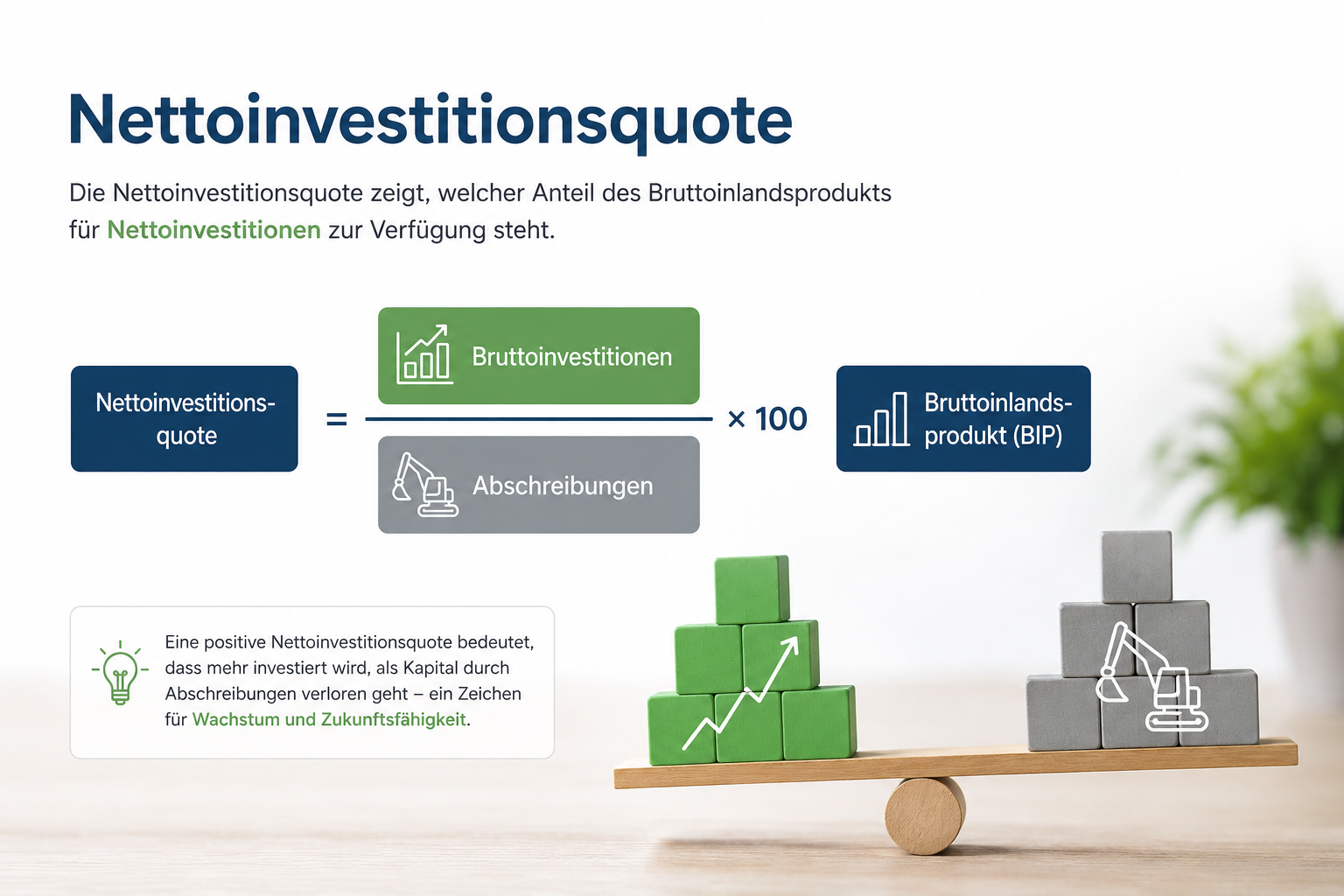
The net investment ratio measures companies’ long-term expenditure on fixed assets such as machinery, buildings and vehicles, after depreciation. Put simply, it shows whether businesses are investing beyond merely maintaining their existing asset base – and therefore whether they are investing in their future.
New data reviewed by my colleague Julian Olk now shows that in 2024 and 2025, depreciation exceeded investment. For the first time since German reunification, the country’s overall stock of fixed assets has declined.
There are, however, significant regional differences. Data broken down by federal state is available up to 2023 and shows negative net investment ratios in states including Thuringia, Bremen and North Rhine-Westphalia. By contrast, the ratio remains positive in Bavaria, Hesse and Berlin.
Germany’s Shrinking Capital Stock: What Works Councils Need to Know
The term “net investment ratio” initially sounds technical and relatively harmless – like an indicator from an economics or business textbook. In reality, however, it reveals something fundamental about the state of the German economy: are companies still investing in their future, or are they simply relying on their existing asset base?
This is where a growing problem is emerging.
When depreciation exceeds investment
The net investment ratio measures companies’ long-term expenditure on fixed assets such as machinery, buildings and vehicles, minus annual depreciation. In simple terms, it indicates whether companies are modernising and expanding their capital stock or whether that stock is gradually declining.
New data points to a historic development: in 2024 and 2025, depreciation exceeded investment. This means that Germany’s overall stock of fixed assets declined for the first time since reunification.
This is more than a statistical anomaly. It is a warning sign.
If companies consistently invest less than the value their existing assets lose through depreciation, the consequences can include:
- ageing production facilities,
- postponed modernisation,
- fewer innovations,
- declining competitiveness,
- and, in the longer term, increasing pressure on jobs.
Why this matters for works councils
For works councils, this development is highly significant. Investment decisions often determine:
- whether sites remain viable,
- whether new technologies are introduced,
- whether employees receive the training they need,
- and whether employment can be secured in the long term.
Where investment is lacking, pressure to rationalise operations often increases. Companies may then attempt to compensate for declining productivity through cost-cutting measures – frequently at the expense of employees.
A negative net investment ratio can therefore serve as an early indicator of structural problems within individual companies or across entire regions.
Significant differences between Germany’s federal states
The picture varies considerably from region to region. Data available up to 2023 already reveals clear differences between Germany’s federal states.
The situation is particularly challenging in states including:
- Thuringia
- Bremen
- North Rhine-Westphalia
Here, the net investment ratio is already negative. In other words, companies are investing less than the value their existing assets are losing through depreciation.
The picture is currently more positive in:
- Bavaria
- Hesse
- Berlin
Here, investment in modernisation and future competitiveness remains stronger.
These differences illustrate that Germany’s industrial transformation is not progressing uniformly. While some regions are attracting new technologies and investment, others are coming under increasing pressure.
The structural challenges are becoming visible
The debate about Germany’s economic future often focuses on individual industries, energy prices or bureaucracy. The net investment ratio, however, highlights a more fundamental issue: Germany as a whole is investing too little in its economic future.
When companies hold back investment over a period of years, structural problems gradually emerge:
- lower productivity,
- weaker capacity for innovation,
- increasing competitive pressure,
- and, in the long term, declining industrial value creation.
For employees, this means growing uncertainty. For works councils, it means taking an even closer look at companies’ investment strategies.
Works councils should make investment strategy a key topic of discussion – rather than waiting until job cuts are announced.
Key questions for works councils
- How is investment at the site developing?
- Are machinery and production facilities being modernised?
- Are there genuine projects for future growth, or primarily cost-cutting programmes?
- What training and skills development measures accompany technological change?
- What is the company’s long-term strategy?
One thing is clear: securing the future of a business is not achieved through short-term cost reductions alone, but through sustainable investment.
The net investment ratio is therefore much more than an economic indicator. It is a barometer of the future viability of companies and business locations – and, ultimately, of employment in Germany.